
Fast Power Sports / Race platform
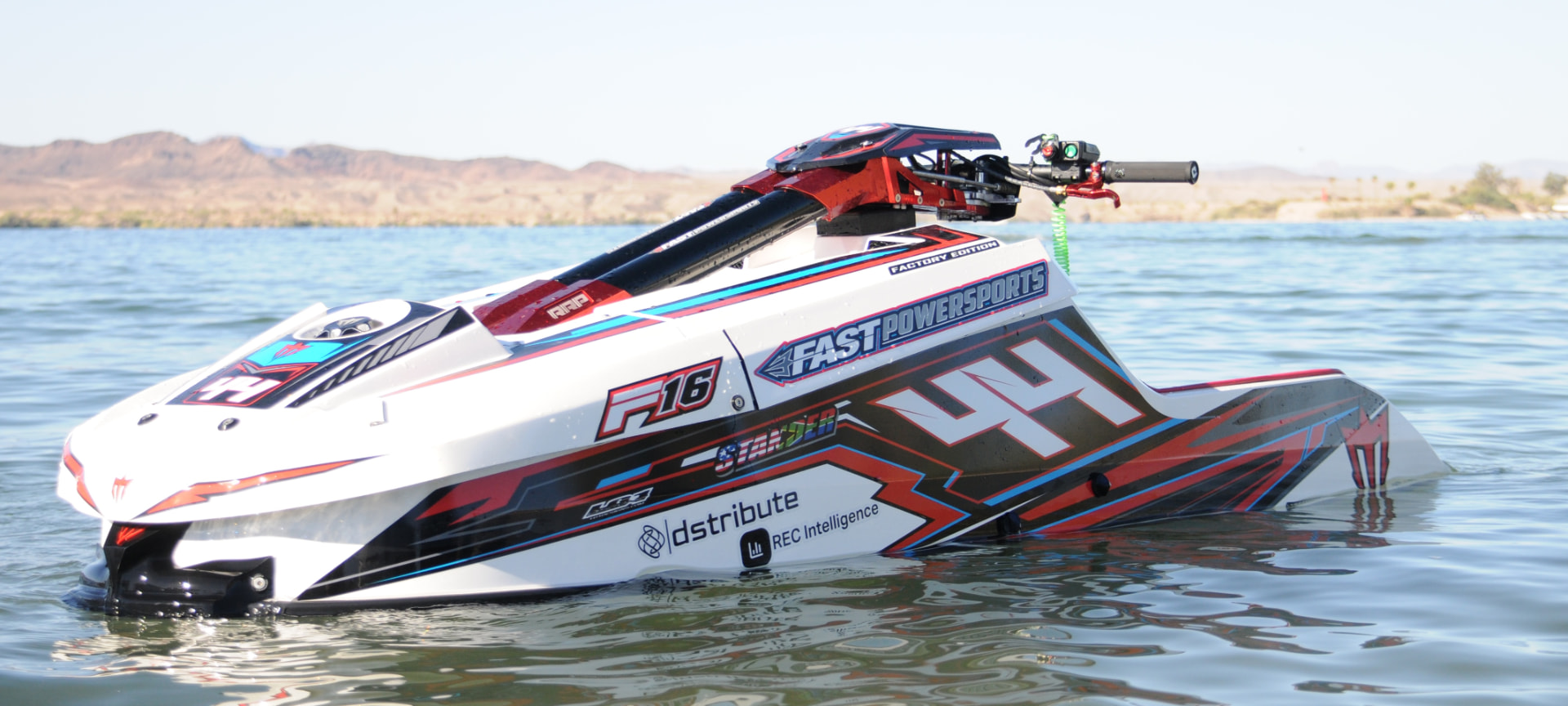
The next-generation hull: quickest rotation, new tray, lower hood and a bigger engine bay for Kawasaki 1500 or Yamaha 1050 power.
Build yoursEngine platforms
Kawasaki 1500 or Yamaha 10501050 package output
115–125 hp (builder stated)Pump
148mm with drop nozzleIntroduced
2025 model platformOverview
The F16 in detail.
The F16 is the newest Fast Power Sports race platform, developed by Dustin and Tyron Motzouris. It carries the GP1R's race DNA into a re-engineered chassis built for the quickest possible rotation, with a redesigned tray, a lower hood profile and a far more accessible engine compartment.
The F16 hull is designed around the Kawasaki 1500 four-stroke, but its engine bay is deliberately oversized. That means a rider moving up from a Yamaha Super Jet can transplant a 1050 engine straight into the F16 and keep their existing package, then step up to 1500 power later without changing hull.
Where the GP1R is the proven flagship, the F16 is the sharper instrument. Authorised builders describe it as the quickest-turning hull in the range, with higher top speeds than the platform it evolved from, a new tray design, an improved low-profile hood and a new engine compartment that makes motor and electronics access far quicker on race day.
Like the GP1R, the F16 is completed to the rider's specification, so the engine, pump, nozzle and tune are chosen for the class, the water and the rider rather than fixed in a brochure.
Powerplant
Engine and power options
Two engine routes into the same hull: the Kawasaki 1500 the chassis was designed around, or a Yamaha 1050 for riders carrying an existing package across from a Super Jet.
- Primary engine platform
- Kawasaki 1500 four-stroke inline-four — the hull is designed around it
- Alternative engine option
- Yamaha 1050 (Super Jet) engine, fitted in customer builds
- Engine bay
- Oversized bay allows straightforward fitment of either platform
- 1050 package output
- 115–125 hpStated by the builder for a specific 1050 configuration, not a universal rating.
- 1500 package output
- Confirmed per build specificationAwaiting confirmationPublished as awaiting Fast Power Sports confirmation. Exact figures are confirmed in writing during your build consultation.
- Aspiration and cooling
- Naturally aspirated, liquid-cooled
- Fuel
- Configurable for 93 octane pump gas, E85 or race fuel depending on tune
- Fuel tank position
- Front tank fitment supported
On the water
Performance and handling
The F16 was engineered to rotate faster than anything Fast Power Sports had built before, while carrying more speed down the straight.
- Handling character
- Quickest-turning hull in the Fast Power Sports range
- Straight-line
- Higher top speeds than the platform it evolved fromA relative claim by authorised builders; no numeric figure is published.
- Top speed
- Build-dependent — confirmed per specificationAwaiting confirmationPublished as awaiting Fast Power Sports confirmation. Exact figures are confirmed in writing during your build consultation.
- Hull length / beam
- Confirmed per build specificationAwaiting confirmationPublished as awaiting Fast Power Sports confirmation. Exact figures are confirmed in writing during your build consultation.
- Dry weight
- Confirmed per build specificationAwaiting confirmationPublished as awaiting Fast Power Sports confirmation. Exact figures are confirmed in writing during your build consultation.
- Intended use
- Closed-course competition and high-level freeride
Chassis
Hull, tray and ergonomics
Every contact point between rider and machine was revisited, along with how quickly a crew can get into the ski between motos.
- Platform lineage
- Shares the GP1R's race DNA, re-engineered throughout
- Tray
- New tray design
- Hood
- Improved low-profile hood
- Engine compartment
- Redesigned for faster access to motor and electronics
- Tray padding
- Traction padding specified per build (JETTRIM and similar)
- Model platform
- Introduced as the 2025 Fast Power Sports F16
Driveline and controls
Pump, steering and controls
Driveline hardware is matched to the engine package. These items have been specified on documented F16 builds.
- Pump
- 148mm pump with matched impeller
- Nozzle
- Drop nozzle
- Pump hardware
- Magnesium pump housing on the documented 1050 build
- Handlepole and steering
- Billet race handlepole and steering specified per build
- Intake grate and ride plate
- Specified with the hull packageExact parts confirmed at consultation.
- Exhaust
- Race exhaust matched to the engine package
Build options
Specify your machine.
Every F16 is completed to the rider's program. These are the routes into the platform.
Bare hull
The F16 hull package for owners and authorised builders completing their own machine, with the hardware included confirmed directly during the build consultation.
Kawasaki 1500 build
The configuration the hull was designed around, for modified-class closed-course racing with the full four-stroke race package.
Yamaha 1050 build
For riders stepping out of a Super Jet hull. The existing 1050 engine and package transplant into the F16's oversized engine bay, with a documented 115–125 hp output on that configuration.
Graphics and finish
Livery, colour and graphics options are confirmed with Fast Power Sports as part of your build consultation.
Questions
F16 questions, answered.
What engine does the Fast Power Sports F16 take?
The F16 hull is designed around the Kawasaki 1500 naturally aspirated four-stroke, but its oversized engine bay also accepts a Yamaha 1050 engine, which makes it a straightforward step up for riders coming from a Super Jet hull.
How much horsepower does an F16 make?
Fast Power Sports has publicly stated 115 to 125 horsepower for a specific Yamaha 1050 F16 configuration. Output on a Kawasaki 1500 package depends on the engine build and tune and is confirmed for your exact specification during the quote process.
How fast is the F16?
Authorised builders describe the F16 as reaching higher top speeds than the platform it evolved from, but no numeric top-speed figure is published. Any number you see quoted elsewhere online is unsourced. Your build's figures are confirmed directly by Fast Power Sports.
What is different about the F16 compared with the GP1R?
The F16 carries the GP1R's race DNA but is re-engineered as the quickest-turning hull in the range, with a new tray design, an improved low-profile hood, higher top speeds and a redesigned engine compartment for much faster access to the motor and electronics.
Can I put my Super Jet engine in an F16?
Yes. The F16 was built with a large engine bay specifically so a 1050 from a Yamaha Super Jet can be fitted, letting riders upgrade hull first and engine later.
What pump does the F16 run?
A documented F16 build runs a 148mm pump with a drop nozzle, a magnesium pump housing and an impeller matched to the engine package. Your driveline is specified to suit your engine and class.
Who developed the F16?
The F16 was developed by Dustin and Tyron Motzouris at Fast Power Sports, building on the GP1R programme.
Comparing platforms
Looking at the GP1R instead?
The proven championship stand-up race hull, built around the Kawasaki 1500 four-stroke platform.
View the GP1RYour program starts here
Talk to the builder.
Tell us how you ride, where you race, and what you expect from the machine. Full specifications and options are confirmed directly.
Request F16 quote